
Polyaspartic Floor Coatings San Antonio
Where Polyaspartic Is Used
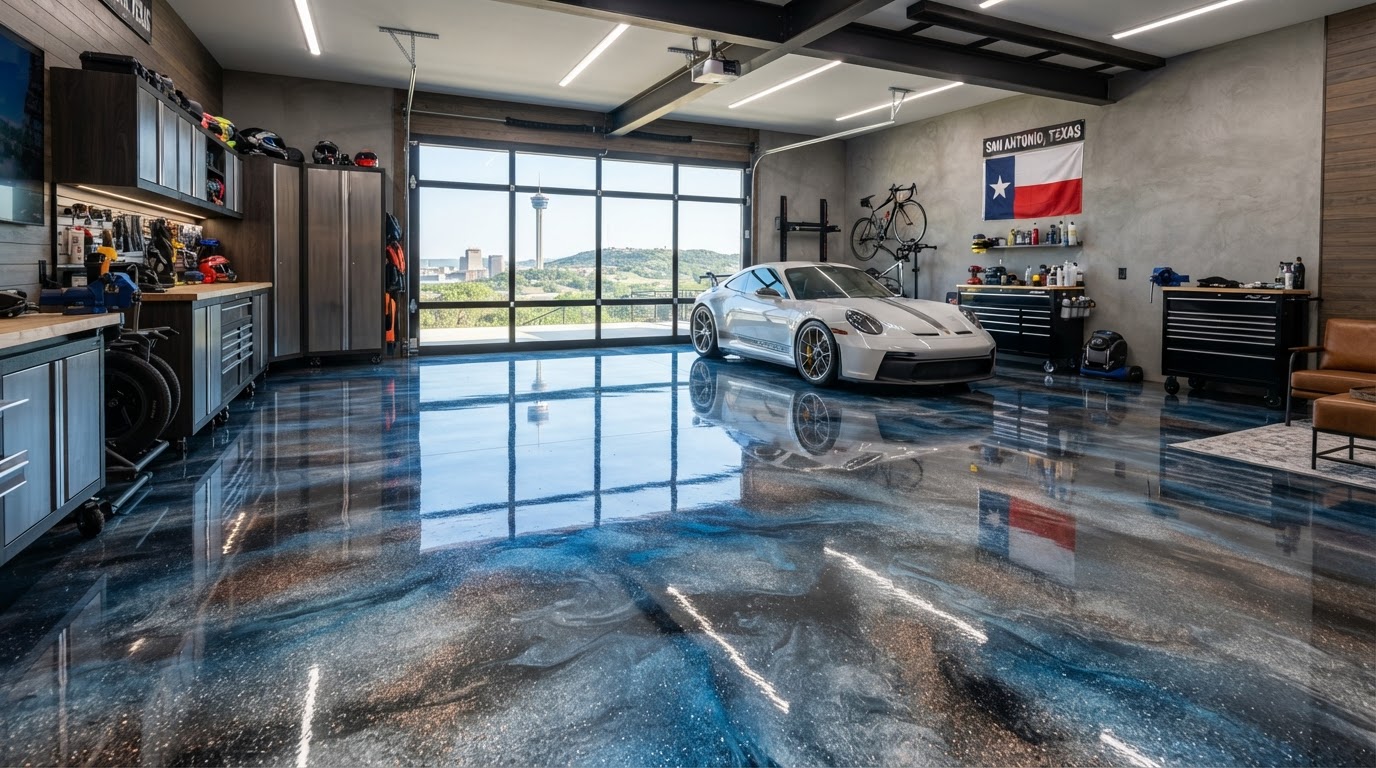
Polyaspartic coatings serve a range of residential and commercial spaces. Common applications include residential garages, workshops, commercial spaces, utility spaces, showrooms, selected industrial environments, flake systems, and sun-exposed threshold areas.
Faster return-to-service can be attractive, which is why polyaspartic is often considered for garages and commercial floors that need to be back in use quickly. Dry Coats avoids exact cure-time promises, since timing depends on the product and conditions.
Preparation & Installation
Polyaspartic preparation follows the same principles as other resinous flooring. The slab is evaluated, profiled, and repaired before any coating is applied.
- Concrete evaluation — checking condition, cracks, and existing coatings.
- Grinding / profiling — mechanically preparing the surface.
- Repairs — addressing suitable cracks and defects.
- Moisture — evaluating conditions that affect coating selection.
- Dust removal — cleaning the prepared surface.
- Base coat — applying the resin layer.
- Optional flake broadcast — adding decorative chips where desired.
- Topcoat — finishing the system with a protective clear coat.
- Cure window — allowing the system to reach service readiness.
Fast cure means installation technique and working time can become more demanding. Dry Coats does not provide unsafe or DIY chemical mixing instructions. The system is installed by professionals who understand the working time of the product being used.
Polyaspartic vs Epoxy
Polyaspartic and epoxy are different resin technologies, and the comparison is worth understanding rather than collapsing into a single answer.
- Cure characteristics — polyaspartic is often selected for faster cure.
- UV stability — many polyaspartic systems offer improved UV stability depending on the product.
- Working time — faster cure can mean a shorter application window.
- Decorative options — both support flake and solid-color finishes.
- Floor system design — polyaspartic can be a base, a topcoat, or a full system.
- Substrate preparation — both require proper mechanical preparation.
- Cost variables — pricing depends on the system, preparation, and scope.
Epoxy and polyaspartic systems can both be valuable, but the best choice depends on the floor, environment, desired appearance, and performance requirements. Dry Coats does not declare a universal winner. See the epoxy flooring page for the broader system context.
Polyaspartic Floors in San Antonio
San Antonio's warm climate and garage-door UV exposure make polyaspartic a relevant option for residential garages, commercial spaces, and workshops. Decorative flake systems using a polyaspartic base or topcoat are popular for garages that need both appearance and performance.
Ready to start? Request a detailed estimate from Dry Coats Painting & Contracting.